
Allergy Vaccine (Immunotherapy) in Islamabad: How It Works, How Long It Takes, and What to Expect
Allergy tablets give relief for a day. Allergy vaccine — also called immunotherapy — is the only treatment that tries to change the allergy itself. At the NIH Allergy Center Islamabad, it is the main long-term treatment offered after a positive allergy test. Yet it is also the most misunderstood treatment at the center: patients ask why it is not working after a few weeks, whether a frozen vaccine is still usable, and what they can eat during the course. This guide answers those questions honestly.
What is allergy vaccine (immunotherapy)?
Allergy vaccine is not a vaccine against an infection. It is a treatment made from the very substances you are allergic to — such as pollen, dust mites, or moulds — given in small, gradually increasing doses. Over time, the immune system learns to tolerate those substances instead of overreacting to them. Symptoms reduce, the need for daily tablets usually falls, and for some patients the benefit lasts even after the course ends.
The most common form is allergy shots (subcutaneous immunotherapy): injections given at a clinic. Another form, sublingual immunotherapy, uses drops or tablets under the tongue, usually taken at home. Which form suits you depends on your allergy, your test results, and the center’s own protocol — at the NIH center, the established course is the injectable vaccine given over about three years.
How does the course work? The two phases
1. Build-up phase (first 3 to 6 months). You receive injections once or twice a week, with the dose increased gradually at each visit. This phase trains the immune system step by step. Because the dose is rising, this is also the phase when mild reactions are most likely.
2. Maintenance phase (up to 3 to 5 years in general; about 3 years at the NIH center). Once the effective dose is reached, injections are spaced out — typically every two to four weeks — and continued for years. The long duration is not a delay or a money-making exercise; it is how long the immune system needs to build lasting tolerance.
After each injection, patients are observed at the clinic for about 30 minutes, because serious reactions, though rare, usually appear quickly. You should also avoid strenuous exercise for a couple of hours before and after a dose, and skip a dose day if you have fever, wheezing, or hives — and tell the clinic first.
When will I feel better? The honest answer
This is the question the center’s Facebook Page hears most, and the answer disappoints some patients: not in a few weeks. Many patients notice some improvement in the first few months, but full benefit can take a year or more on the maintenance dose, and the course continues for years after that.
So if you started the vaccine in August and September still felt bad, that does not by itself mean the treatment has failed — it may simply be too early to judge. On the other hand, if there is less than half improvement after about six months of regular treatment, that is the right time to discuss the plan with the center’s doctors rather than stopping on your own. Stopping early wastes the investment already made and the tolerance already built.
Side effects: what is normal and what is not
Common and usually mild: redness, swelling, or itching where the injection was given, and sometimes a temporary increase in sneezing or nasal congestion. These settle on their own.
Uncommon but serious: widespread hives, throat swelling, wheezing, chest tightness, dizziness, or a drop in blood pressure. These are signs of a severe allergic reaction and need immediate medical attention — one more reason every dose is given where emergency care is available, and why the 30-minute observation after each shot matters.
Immunotherapy is not suitable for everyone. It is used with caution in people with uncontrolled asthma, and some blood pressure medicines can interfere with the medicines used to treat a severe reaction — so your full medicine list must be shared with the clinic before starting.

Questions patients actually ask
What if my vaccine freezes?
Allergy vaccines must be stored as directed — usually refrigerated, never frozen. If a vial has frozen, do not use it on your own assumption. Take it to the center or ask the center’s team whether it is still usable; a damaged vaccine may not work, and guessing wrong wastes a dose or risks a reaction.
What foods should I avoid during the vaccine course?
There is no universal diet for immunotherapy patients. Unless your own doctor has identified a food allergy and advised avoidance, no special food restrictions apply during the course. Follow the center’s advice for your own case rather than general food lists found online.
Does the vaccine work for everyone?
No. Most patients improve, some improve a lot, and a minority do not respond well. Response depends on the allergy type, the dose, and completing the course. That is why the center reviews progress over months, not weeks.
Can I get the vaccine in my own city?
After a first visit and prescription at the NIH center, vaccine delivery across Pakistan is available, which is how out-of-city patients continue the course. The first visit itself, including testing, happens at the center in Chak Shahzad. See our NIH Allergy Center complete guide for the full first-visit process, timings, and appointment guide.
What does the vaccine course cost?
At the NIH Allergy Center, the vaccine is part of the first-visit figure published on the center’s fees page — consultation, vaccine, and skin prick test together cost Rs 1,700, with outside medicines around Rs 2,000 to 4,000. The long-term course, follow-ups, and medicines form an ongoing cost beyond day one, so ask the center for the full course plan and expected total at your first visit. Our allergy test price guide explains what affects the total cost.
Before you start: the checklist
Before starting immunotherapy, confirm four things: your allergy test is positive and matches your symptoms; you are in the center’s eligible age range (tests are not done for children under 10 or patients over 60, per the center’s own notice); your asthma, if any, is under control; and you can commit to regular visits for years, not weeks. If any of these is uncertain, discuss it with the center before the first dose.
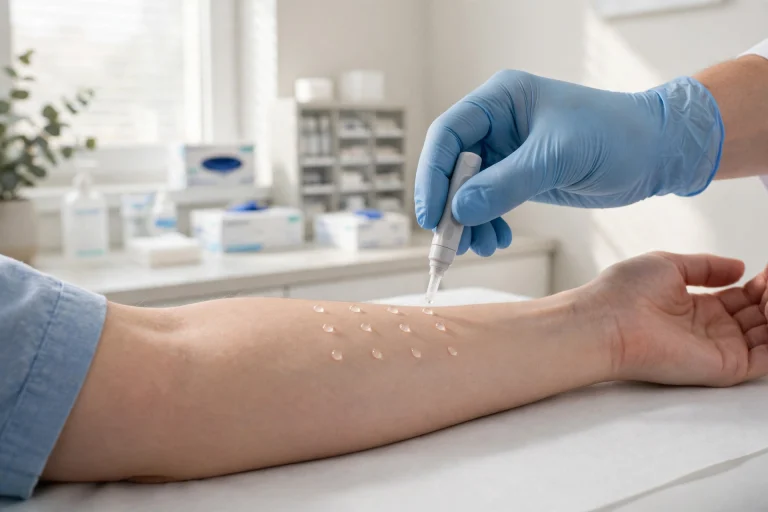
If you are still deciding whether testing is right for you, read our skin prick test guide first — testing is the step that makes immunotherapy possible.
The bottom line
Allergy vaccine is a slow treatment for a long-term problem. It does not work in weeks, it is not a tablet you can stop and restart casually, and it is not for everyone — but for patients with confirmed allergies who complete the course, it is the treatment most likely to reduce symptoms for years. Go in with the right expectations, keep every appointment, and judge the result after months of regular treatment, not after the first few doses.
Disclaimer: This article is for general information only and is not a substitute for medical advice. Immunotherapy decisions, storage questions, and side effects should always be discussed with the center’s doctors.